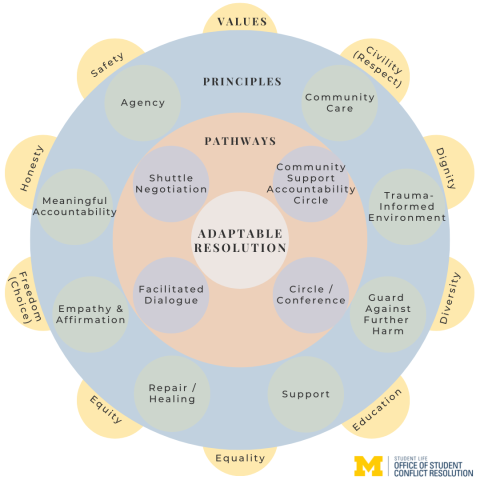
Adaptable Resolution (AR) for students is a voluntary and restorative process used to address harm within the community stemming from sexual and gender-based misconduct. AR is one of the Resolution Pathways under the U-M Sexual and Gender-Based Misconduct Policy and student procedures for Ann Arbor, Dearborn, Flint.
Getting Started: To begin the AR process, students must file an SGBM Report with the Equity, Civil Rights, and Title IX Office (ECRT). From there, students may have a number of resolution options available to them, including Educational Conversations, Investigative Resolution, and Adaptable Resolution.
Eligibility: AR is available to anyone who has filed a formal complaint under the Policy, so long as the Respondent is a U-M student. The formal complaint must then be approved for AR by the Title IX Coordinator. To determine approval, the Title IX Coordinator will consider:
The safety of the parties and the campus community
The Complainant’s and Respondent’s interest in participating in AR
The Complainant’s and Respondent’s opportunities to freely choose among resolution options
Whether the University has Title IX obligations to investigate the matter, and if so, whether the University has, or has means to obtain, sufficient information about the alleged conduct to carry out an investigative resolution process.
AR is Voluntary: Complainants and Respondents have the agency to end the process at any point, and other individuals (involved or impacted parties) can choose to withdraw their participation at any time before a Resolution Agreement is signed. The University or any University office may not pressure or compel anyone to participate.
AR is Restorative: AR creates space for those who have experienced harm to explore, alongside a trained facilitator, a spectrum of pathways co-created to meet expressed needs. Rather than focusing on what policies have been broken, restorative processes aim to help people and communities be made whole.
AR is Private: Conversations about and within the AR process are kept private as we seek to create an environment that cultivates open and honest communication. This means that information shared during the AR process is not typically disclosed to others at the University, other than the Title IX Coordinator, including for other disciplinary purposes. By signing a participation agreement, complainants and respondents agree that, to the extent permitted by law, they will not use information shared or obtained during AR in any other University process (including Investigative Resolution under the Policy even if Adaptable Resolution does not result in an agreement) or legal proceeding.
In the AR process, there will be no formal disciplinary action taken against a Respondent, and the resolution will not appear on the Respondent’s disciplinary record.
Facilitation Pathways:
- Facilitation Pathways that do not include face-to-face interaction
- Restorative Shuttle Agreement: A negotiated agreement between the Complainant and the Respondent to discuss perspectives and experiences, and explore interests while working towards meeting expressed needs.
- Circle of Support and Accountability: A facilitated interaction between the Respondent and University designees designed to provide accountability, structured support, and the development of a learning plan.
- Facilitation Pathways that include face-to-face interaction (including virtual meetings)
- Facilitated Dialogue: A structured and facilitated conversation between the Complainant, the Respondent, and/or other community members. The focus is often on providing a space for voices to be heard and perspectives to be shared.
- Restorative Circle or Conference: A facilitated interaction where the Complainant and other agreed-upon parties come together with the Respondent who assumes responsibility for repairing the harm (to the extent possible).
Contact: If you have any questions about AR or would like to learn more, please reach out to us at OSCR.Adaptable.Resolution@umich.edu
Confidential Resources: If you would like to reach out to a confidential resource to help you understand your options and rights, please contact Counseling and Psychological Services, Sexual Assault Prevention and Awareness Center, Sexual Assault Services at University Health Services, Spectrum Center, University Ombuds, or Wolverine Wellness.
Non-Confidential Resources: To receive help in filing an SGBM Report to ECRT, students can reach out to Dean of Students, Respondent Support Program, CEW+, or U-M Police Dept - Special Victims Unit.